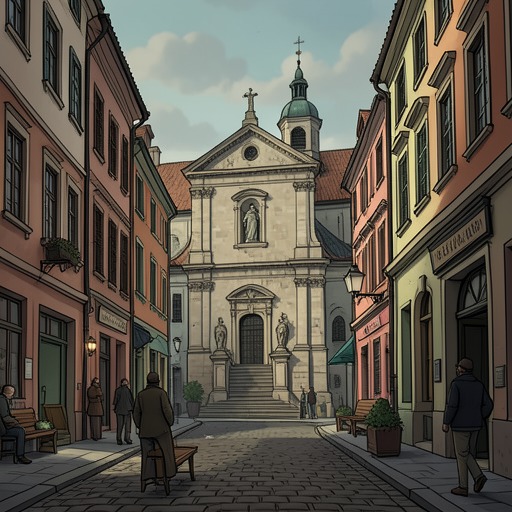
Plaza Virgen de los Reyes
La piel del tamborPlaza Virgen de los Reyes is a central public square in Seville and a recurring vantage point in Lorenzo Quart’s investigation. From a hotel room overlooking it to its benches and evening streets, the square gathers the novel’s contrasting Seville: ecclesiastical authority and modern journalism, old urban memory and contemporary commerce, apparent calm and covert surveillance.
Setting and View
From his room, Quart looks across the square from a window beside two canopy beds. After completing an eight-page report for Paolo Spada, he studies books about Seville and a copy of Q+S, then notices an old postcard showing the Church of Our Lady of Tears as it stood in 1895. The card’s view includes the church façade and the square in front of it, where a vegetable seller serves two women and a water carrier’s donkey recedes along a narrow street. The historic image makes the square more than a passing urban backdrop: it links Quart’s present-day inquiry to a version of the city that has already begun to fade.
The square also serves as a threshold between the enclosed hotel and the streets where Quart’s investigation becomes visible to others. At dusk, he leaves the hotel with Honorato Bonafé following him. The remaining light cuts out the silhouette of the Giralda, and lamps come on across the square as Bonafé tries to draw him into an exchange of information. The scene turns a familiar civic space into the setting for an attempted journalistic approach and Quart’s wary refusal.
Observation and Surveillance
A bench in the square becomes a surveillance post for Don Ibrahim and Niña Puñales, who watch the entrance to Hotel Doña María. While Don Ibrahim fans himself with his hat, Niña works on a piece of her wedding trousseau, silently repeating a knitting sequence as the fabric grows in her hands. The task has continued for nearly thirty years, her unfinished bridal hopes preserved in an accumulating dowry. The square’s everyday stillness thus conceals both a long private suspension and a practical operation: the pair are keeping watch.
After Quart turns away from Bonafé, he crosses the square absorbed in the problem of the journalist intruding into church affairs. He fails to notice a couple following him at a distance. The man in a white suit and Panama hat and the woman in a spotted dress walk arm in arm like an unremarkable married pair, but they exchange a knowing look with another watcher near the Giralda bar. The apparent ease of the scene is part of its cover; once Quart enters La Albahaca, Don Ibrahim sends Potro del Mantelete to report to Celestino Peregil, and Peregil comes to inspect the group’s positions.
The Square in the Investigation’s Wider Pattern
The square’s recurring role is one of looking and being looked at. Quart uses his room’s view to examine materials bearing on Seville’s past and present; Bonafé approaches him there as a journalist; and Don Ibrahim’s group tracks his movements from the hotel entrance into the surrounding streets. These activities make the square a connective space between investigation, media interest, and organized surveillance, without turning it into the site of the church deaths themselves.
Its social texture also carries a note of elegy. As a horse-drawn carriage crosses the square with English football supporters drinking beer in Cordoban hats, Don Ibrahim watches it and laments Seville’s condition. Niña acknowledges him without lifting her head from her knitting. The passing spectacle contrasts with her patient, decades-long work and with the 1895 postcard’s disappearing figures; the square holds together a changing city and people whose habits remain fixed in time.